Garmin’s New Fenix 9 and Fenix 9 Pro Bring Faster Mapping
 androfyi September 1, 2026 9 min read 106 views
The No-BS Verdict: If you run trails, navigate unfamiliar cities without a phone, or plan routes directly on your wrist, the Fenix 9 earns its price purely on mapping alone. If you only track gym sessions and daily steps, this is a $1,000+ mistake that delivers nothing a $300 watch cannot. The Fenix 9 Pro only makes sense if you specifically need titanium, satellite texting, or the brightest AMOLED screen possible; otherwise, the base model delivers nearly identical mapping performance for less money.
Real-World Gotchas: The Good & The Bad
The Good
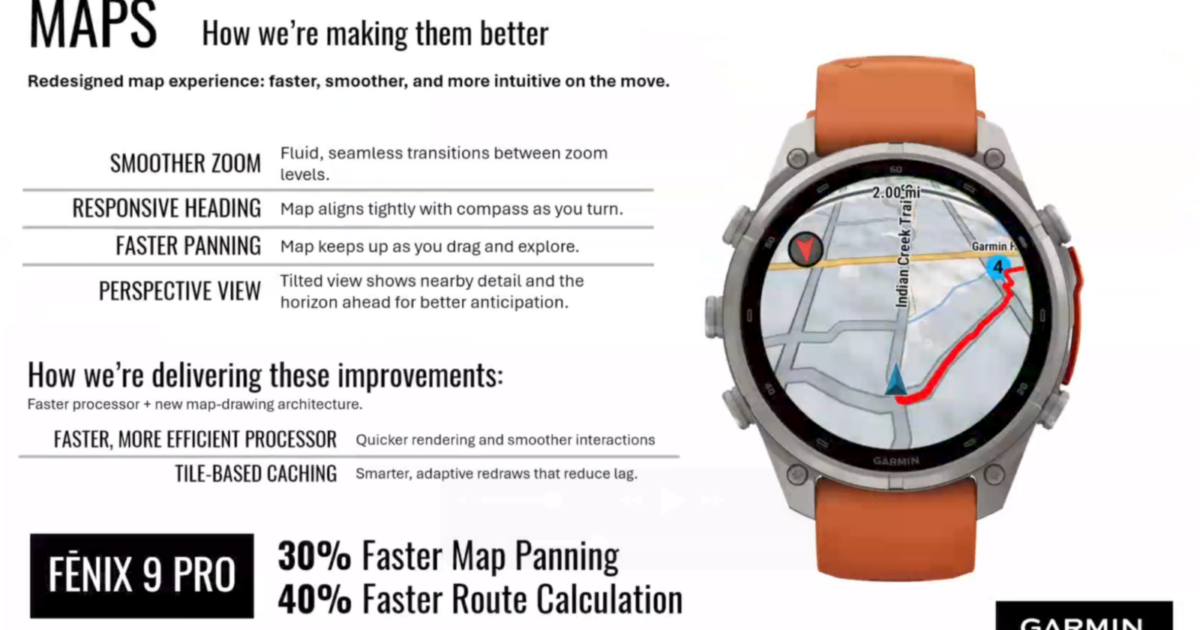
- Mapping Speed: The new map engine caches tiles around your current view, making panning dramatically faster. Round-trip routing calculates roughly 40% faster than the Fenix 8 Pro.
- RAM Bump: 50% more memory than the Fenix 8 means map rendering stays responsive even with complex topographic data loaded.
- Storage Doubled: 64GB fits twice as many maps as the previous generation plus up to 7,000 songs for phone-free listening.
- Perspective View: The new tilted map view adds depth, helping you anticipate upcoming turns and terrain before you reach them.
- Pro Tier Expansion: For the first time, the 43mm size gets the full Pro treatment including titanium and satellite connectivity.
- ComfortFit Bands: New fabric accessory bands combine stretch, softness, and moisture resistance using the QuickFit connector system.
The Bad
- Still Not Instant: Rapid swiping and aggressive zooming still causes map tiles to blank out momentarily. It is better, but not solved.
- Fenix 8 Owners Get Burned: The new mapping engine is exclusive to Fenix 9. Your older watch will never receive it, despite sharing similar silicon.
- Elevate Gen 5 Again: The optical heart rate sensor is identical to the Fenix 8. No hardware upgrade here.
- Price Creep: Base starts at $999.99, Pro at $1,099.99. The 51mm Pro with solar pushes toward $1,300.
- SatIQ Confusion: The forced multi-band option is gone. All versions now use SatIQ automatic switching, which some power users find less predictable.
Warning Configurations
- LTE/Satellite Models: Only select Fenix 9 Pro configurations include inReach and LTE. Check the specific SKU carefully before assuming connectivity is included.
- Solar Availability: Solar charging displays are limited to specific Pro models, not the entire lineup.
- ArcheryX Feature: This new archery tracking feature will not backport to older watches. It is Fenix 9 exclusive.
I have spent considerable time with the Fenix 8 Pro, logging thousands of miles across trail runs and urban navigation tests. The single most consistent complaint from the community was never battery life or GPS accuracy. It was the maps. Switching between data screens and returning to the map view meant staring at a blank display while the processor caught up. Panning felt like dragging a cursor through wet concrete. Garmin heard this loud and clear. The Fenix 9 series does not just iterate on the mapping experience. It rewrites the underlying engine entirely, and the difference is immediately tangible on your wrist.
Design Language Broken Down
The Fenix 9 retains the aggressive, angular silhouette that has defined the line for years. This is not a watch trying to dress up for the office. It is a tool watch that happens to tell time. The base model keeps the established construction with a fiber-reinforced polymer case and metal backplate. The Pro steps up to titanium, which Garmin says reduces overall thickness while maintaining rugged durability through a nano-molding process that bonds metal and plastic at the molecular level.
The 51mm Pro model introduces Garmin’s first 1.5-inch AMOLED display, extending the screen by 15% over the Fenix 8 without increasing the case size. Peak brightness hits 3,000 nits on Pro AMOLED variants, which is genuinely visible in direct sunlight where other watches wash out. The base Fenix 9 AMOLED is rated at twice the brightness of its predecessor, though Garmin does not publish exact nit numbers for the non-Pro panels.
Sapphire lenses, leakproof buttons, 10 ATM water resistance, and dive capability to 40 meters carry over across the lineup. The hardware feels familiar because it is familiar. Garmin got the physical formula right several generations ago and has been refining rather than reinventing.
Under Stress: Framerates & Multitasking
Here is where the marketing numbers meet reality. Garmin claims 30% faster map panning and 40% faster round-trip route calculation compared to the Fenix 8. The Fenix 9 Pro adds a newer processor on top of the base model’s 50% RAM increase, though Garmin admits the real-world speed difference between base and Pro mapping is marginal. The bulk of the improvement comes from the rewritten map engine itself, not just raw silicon.
In practice, the engine pre-loads and caches map tiles around your current viewport. When you scroll, those tiles are already rendered and ready to display. On the Fenix 8, rapid panning left you watching a blank grid while the processor scrambled to catch up. On the Fenix 9 Pro, that blank grid still appears if you swipe aggressively enough, but the threshold is significantly higher. Normal navigation feels fluid. Zoom transitions between elevation levels are smoother. Heading updates as you rotate feel more responsive.
Side by side with the Fenix 8 Pro, the entire user interface on the Fenix 9 Pro feels subtly snappier. Animations appear to render at a higher frame rate. Menu transitions have less stutter. It is not a night-and-day difference in general navigation, but it is noticeable if you have been living with the older hardware. The biggest leap is unquestionably the mapping. It is the best mapping experience I have tested on any Garmin watch, full stop.
The 64GB storage capacity deserves attention beyond just music storage. Garmin’s maps carry significantly more data than competitors. Trendline routing, popular heat maps, points of interest, shelters, water resources, map labels, and contour lines all stack on top of routable road and trail data. Processing all of that in real time demands memory and storage headroom. Doubling both from the Fenix 8 generation is not spec sheet padding. It is a prerequisite for the mapping engine to function as designed.
Sensor Performance & Tracking Nuance
The optical heart rate sensor remains the Elevate Gen 5, identical to what shipped in the Fenix 8 generation. This is not necessarily a criticism. The Gen 5 sensor performs well across steady-state running, cycling, and hiking. It still struggles with high-intensity intervals, heavy wrist flexion during weightlifting, and any activity where the watch shifts on your wrist. If you need clinical-grade accuracy, a chest strap remains mandatory regardless of which Fenix generation you buy.
GPS accuracy using Multi-Band GNSS with SatIQ automatic mode switching is solid and on par with the Fenix 8 Pro. Satellite acquisition is reliable in open sky, dense forest, and urban canyon environments. The SatIQ system intelligently toggles between full multi-band and power-saving modes based on signal conditions. Some power users miss the ability to force multi-band permanently, but for most athletes the automatic switching delivers accuracy without unnecessary battery drain.
Battery life on the 51mm Fenix 9 Pro reaches 31 days in smartwatch mode, up from 27 on the Fenix 8 Pro. Max accuracy GPS mode delivers 45 hours. For context, the Fenix 8 Pro AMOLED 51mm managed 53 hours without always-on display and 41 hours with it. The Fenix 9 Pro appears to land in a similar range, though Garmin has not clarified whether the 45-hour figure assumes always-on is disabled.
Who This Is Actually For
The Fenix 9 is for the athlete who plans routes on the watch, not just the phone. It is for the trail runner who navigates unfamiliar backcountry without cell service. It is for the traveler who wants turn-by-turn directions on their wrist while exploring a new city and refuses to look like a lost tourist staring at a phone on every corner. The mapping improvements alone justify the upgrade if navigation is a primary use case.
The Fenix 9 Pro adds meaningful value for a narrower audience. Titanium construction matters if you want premium materials without adding weight. The 3,000-nit AMOLED display matters if you frequently read the watch in harsh direct sunlight. Solar charging matters if you spend extended time off-grid. inReach satellite connectivity matters if you venture beyond cell coverage and need two-way texting and SOS capability from your wrist. If none of those specific needs apply to you, the base Fenix 9 delivers the same mapping engine, the same RAM increase, the same storage capacity, and the same core navigation experience for less money.
The Fenix 8 owner faces a harder decision. The mapping engine will not backport. The new perspective view will not backport. ArcheryX will not backport. But the GPS accuracy, heart rate sensor, and general performance remain excellent on the older hardware. If maps are not your primary pain point, the Fenix 8 remains a capable watch that Garmin continues to support with software updates.
Garmin Epic, the new feature that groups multiple activities into a shareable story within Garmin Connect, will reach older watches via software update. Stamina curves and zones, the Endurance Score expansions, and the Messenger FindMyPeoples update are not Fenix 9 exclusives. Garmin is smartly reserving the mapping improvements as the hardware-driven reason to upgrade while sharing the software-driven social and training features with the existing user base.
The Fenix 9 starts at $999.99. The Fenix 9 Pro starts at $1,099.99. Both are available in 43mm, 47mm, and 51mm sizes. The Pro adds titanium, brighter AMOLED options, available solar charging, green flashlight mode, and select configurations with LTE and satellite inReach connectivity. The base model gets the same mapping engine, the same RAM increase, the same 64GB storage, and the same core navigation experience. Choose based on materials and connectivity needs, not mapping performance. That part is identical across both tiers.
Tags: Garmin Fenix 9 review, Fenix 9 Pro mapping speed, Fenix 9 vs Fenix 8 upgrade, Garmin new map engine, Fenix 9 Pro titanium, Garmin Fenix 9 battery life, Fenix 9 Pro satellite connectivity, Garmin Fenix 9 price, Fenix 9 AMOLED brightness, Garmin mapping engine RAM, Fenix 9 Pro vs base model, Garmin Fenix 9 navigation review, Fenix 9 inReach LTE, Garmin Epic feature Fenix 9
Related reading