 androfyi
Disclosure: This post contains affiliate links. If you buy through them, we may earn a commission at no extra cost to you.
The No-BS Verdict: If you’re a hobbyist who flies twice a year at the beach, this drone is a colossal waste of money. If you’re a working pro who understands focal length compression, color grading, and needs a reliable tool that survives wind, weather, and production schedules, stop reading and buy it. Everyone else? You’re overpaying for potential you’ll never touch.
Real-World Gotchas: The Good & The Bad
- Telephoto Lenses: The 70mm and 168mm lenses deliver genuine cinematic compression that makes single-camera drones look like toys. This alone justifies the upgrade for working pros.
- Silence: Shockingly quiet for a 1065g aircraft. Critical for urban shoots and not spooking wildlife or subjects.
- Transfer Speeds: All-I files move to your SSD fast enough that large file sizes stop being a workflow bottleneck.
- Wind Resistance: Users report flying through conditions that would ground lesser drones. Stability feels like it belongs in a higher weight class.
- RC Pro 2 Controller: Once customized with C1/C2 and expo tuning, the workflow is seamless. The auto-power-on when unfolding is a small but meaningful time saver.
- Vertical Mode Gimbal Limits: Only 10 degrees of tilt up or down in true vertical mode. Want to point up at a building while shooting vertical? Too bad. Most users end up cropping from normal mode instead.
- Battery Life Reality: DJI claims up to 52 minutes. Real-world moderately windy conditions delivered 35 minutes before forced landing. Plan accordingly.
- No ProRes 4:2:2: Dropped from this generation. Professionals relying on that codec for direct-to-edit workflows must look at the Inspire 3 instead.
- Software Latency: A frustrating 5-second delay appears between shots and lens changes with a vague “processing” message. Unacceptable during time-sensitive shoots.
- Controller Durability Concerns: The folding mechanism feels flimsier than the price demands. Multiple reports of broken units create nagging anxiety during transport.
After aggregating feedback from multiple long-term users and testing periods spanning 2 to 9 months, the Mavic 4 Pro reveals itself as a tool with glaring philosophical contradictions. DJI buried a Dual Gain ISO Fusion feature deep in the menus with zero marketing documentation. Users discovered it independently – a hidden HDR workflow that blends two sensor readouts simultaneously for highlight rolloff that surpasses conventional methods. Why isn’t DJI advertising this? Nobody knows. It sits there, unwhite-papered, waiting for beta testing by anyone willing to dig through settings. Then there’s the Quad Bayer sensor situation. The main Hasselblad 4/3 sensor pushes 100 megapixels. Physics says that’s only achievable with Quad Bayer technology. DJI doesn’t list it in specs – likely marketing caution after the Air 2S debacle where video artifacts exposed the underlying sensor design. Users report no visible Quad Bayer artifacts in video, suggesting DJI split the implementation: Quad Bayer for photos, conventional readout for video. Smart engineering, deliberately obscured.
Design Language Broken Down
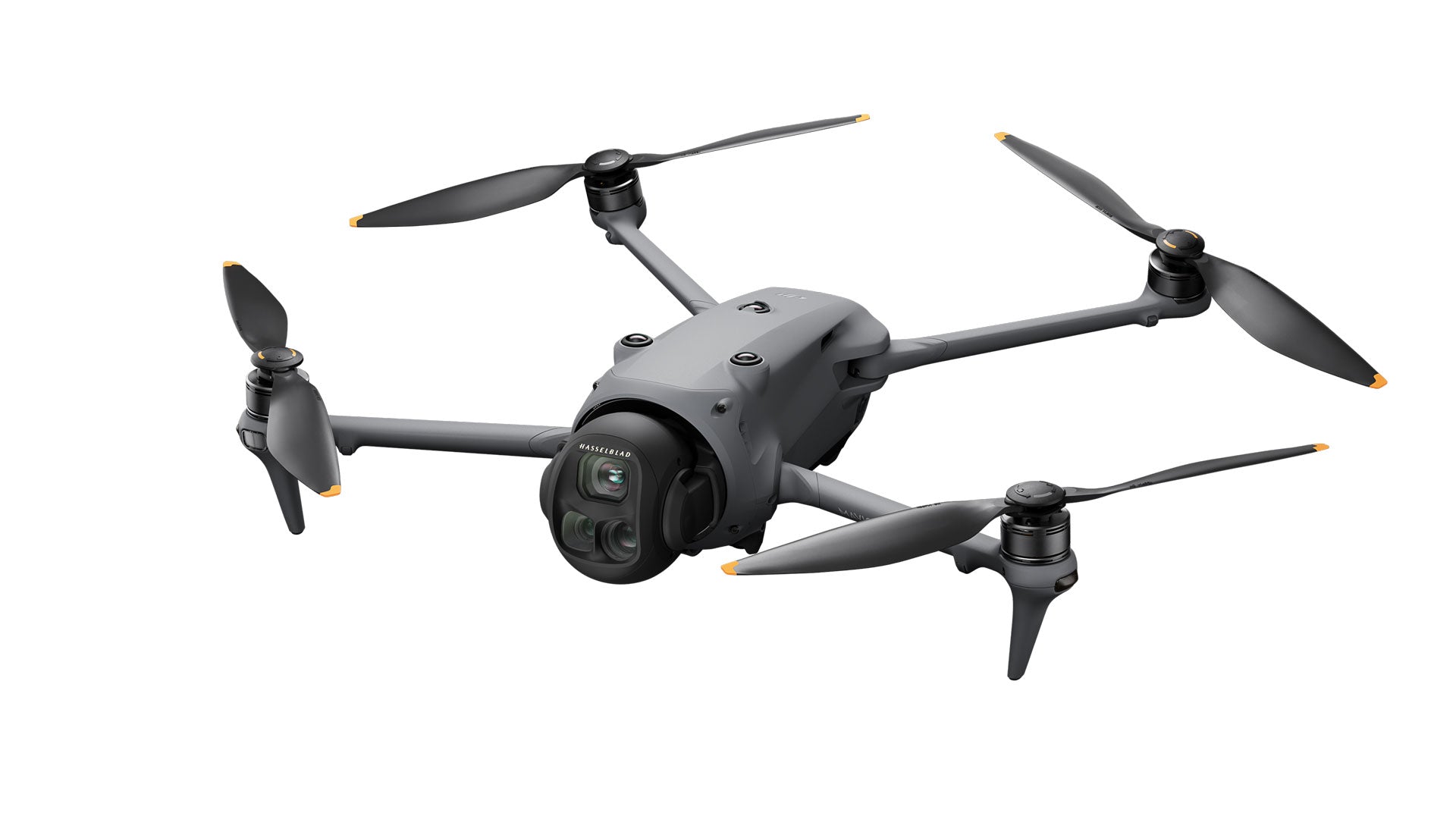
The Mavic 4 Pro doesn’t pretend to be portable. At 1065 grams, it clears the 250g regulatory threshold by a factor of four. This weight becomes an asset in wind, providing the inertia needed for stable footage that lighter drones simply cannot match. The new aggressive aesthetic language signals its intent: this is not a toy. The arms unfold in any order, triggering automatic power-on. The gimbal protector is compact but functional. Build quality across the drone itself is dependable – no creaks, no flex, no sense of corner-cutting. That sentiment does not fully extend to the RC Pro 2 controller.
The C2 label and 83db noise rating mean this drone operates under different flight rules in Europe, particularly regarding proximity to people. DJI claims the drone is quiet enough to meet the standard, and field reports support this – but the regulatory burden remains for operators who previously flew C1-classified aircraft.
Under Stress: Framerates & Multitasking
Menu navigation and mode changes feel snappier than the Mavic 3 Pro. Connection strength remains rock solid even through thick trees and valleys – a far cry from the early Mavic days where signal loss haunted every flight. The Creator Combo ships with three batteries, each delivering enough power for three flights where the Mavic 3 managed two. Top speed sits at a claimed 97.2 km/h, though real-world conditions and obstacle avoidance limitations cap practical speeds around 90 km/h in Sport Mode. The drone feels heavier in flight than the Air or Mini series. Braking distance extends accordingly. Longitudinal acceleration slows. This isn’t a flaw – it’s physics – but pilots switching from lighter DJI aircraft will notice the difference immediately.
The 6K video implementation supports all-key-frame recording, giving editors maximum flexibility in post. Color profiles like D-Log and D-Log M deliver claimed 16 stops of dynamic range through multi-exposure blending. Whether that number is precisely accurate matters less than the practical result: protected highlights and shadows that survive aggressive color grading without falling apart.
Low-Light Extraction & Color Science
Low-light tracking performance surpasses any previous DJI drone in this form factor. The Hasselblad color science on the main camera produces footage that requires minimal correction in post. Where the Mavic 4 Pro truly separates itself is in the telephoto cameras. The 28mm wide-angle performs adequately. The 70mm medium telephoto and 168mm telephoto are where the drone becomes irreplaceable. These lenses create genuine background separation, parallax effects, and scale representation that single-lens drones cannot replicate. Once you incorporate these focal lengths into your workflow, returning to a standard wide-angle feels creatively crippling.
Who This Is Actually For
The Working Cinematographer: You shoot commercial real estate, weddings, or branded content. You understand that lens choice matters as much as camera quality. You need 6K footage that survives color grading. You fly in wind, cold, and variable light. The Mavic 4 Pro is your drone.
The Mavic 3 Pro Owner Ready to Upgrade: You’ve hit the limitations of your current system. The improved battery life, faster menu response, better low-light tracking, and superior telephoto implementation justify the investment. You’ll notice the difference immediately.
The Mini or Air Owner Looking to “Level Up”:strong Stop. Learn your current drone completely before spending this money. The Mavic 4 Pro’s potential will be wasted on pilots who haven’t mastered basic composition, exposure theory, and flight planning. This tool rewards skill it cannot teach.
The Tech Hobbyist Who Wants “The Best”: You will not use 40% of this drone’s capabilities. Buy it if the money doesn’t matter. Otherwise, you’re purchasing specifications you’ll never translate into better footage.
Tags: DJI Mavic 4 Pro review, Mavic 4 Pro vs Mavic 3 Pro, Mavic 4 Pro battery life real world, DJI Mavic 4 Pro vertical mode limitations, Mavic 4 Pro telephoto lens quality, DJI RC Pro 2 controller problems, Mavic 4 Pro wind resistance test, Dual Gain ISO fusion DJI, Mavic 4 Pro ProRes missing, DJI Mavic 4 Pro C2 category regulations, Mavic 4 Pro long term review, DJI Mavic 4 Pro color science, Mavic 4 Pro low light performance, Mavic 4 Pro who should buy