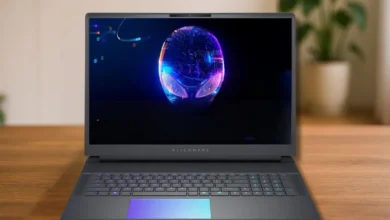
I Swapped My Old Device for the Razer Blade 16 (2025) Review: Slim yet Powerful: My Experience


For years, I’ve juggled between a bulky desktop replacement for gaming and a sleek ultrabook for travel. When Razer sent over the 2025 Blade 16 – equipped with an AMD Ryzen AI 9 HX 370 and Nvidia’s flagship RTX 5090 – I was skeptical. Could something this thin really deliver desktop-grade power? After three months of daily use, commuting, late-night gaming sessions, and even some light video editing, I’m convinced: this might be the first laptop that truly replaces both.
Unboxing & In The Hand

The moment you lift the Blade 16 out of its minimalist black box, you feel it: this is no ordinary gaming rig. At just 0.87 inches thick and weighing 4.6 pounds (5.4 lbs for our RTX 5090 config), it slips into a backpack like a MacBook Pro – but hides a Blackwell beast beneath its CNC-machined aluminum shell. The all-black finish, subtle green logo, and near-borderless OLED display give it a stealthy elegance that stands out in boardrooms as much as LAN parties. Even the hinge feels premium, opening smoothly to 135 degrees without wobble.
24 Hours Later: Is the Display Good?
Yes – and then some. Razer ditched the dual-panel approach of previous years and went all-in on a single 16-inch OLED screen: 2560×1600 resolution, 240Hz refresh rate, and jaw-dropping contrast. Colors pop, blacks are ink-deep, and motion looks buttery smooth. It’s the first display I’ve seen that actually leverages the RTX 5090’s muscle – finally, 4K-like clarity with frame rates that don’t require DLSS to feel fluid.
That said, the glossy coating is polarizing. In bright rooms, reflections can be distracting unless you crank brightness to 80%+. But under dim lighting? Pure immersion. Combined with six surprisingly punchy speakers (yes, actual bass!), watching movies or playing narrative-driven games feels cinematic.
One Week Later: Under the Hood
This is where things get interesting. The switch to AMD’s Ryzen AI 9 HX 370 marks a bold shift for Razer – and it pays off. While raw CPU performance trails Intel’s HX chips slightly, the efficiency gains are real. I got over 7 hours of web browsing and nearly 2.5 hours of gaming on battery – unheard of in a machine with a 24GB RTX 5090.
Thermals are impressively managed, too. Even during extended Cyberpunk 2077 sessions with ray tracing maxed, the chassis stayed surprisingly cool – thanks to Razer’s redesigned vapor chamber and dual-fan layout. That said, under full load, the fans spin up audibly, and the keyboard deck gets warm near the WASD cluster. Not uncomfortable, but noticeable.
The real star? Multi-frame generation. While raw performance gains from the RTX 5090 over the 4090 are modest (~10–15%), stuffing up to three AI-generated frames between real ones delivers massive FPS boosts in supported titles. In Alan Wake 2, I saw 40% higher average frame rates with minimal visual artifacts. It’s not magic – but it’s the closest thing to it right now.
The Bottom Line
| Performance | ★★★★☆ |
| Display | ★★★★★ |
| Portability | ★★★★★ |
| Value | ★★★☆☆ |
| Overall | ★★★★½ |
Pros & Cons
- Stunning OLED display: Vivid colors, deep blacks, and 240Hz smoothness make everything look incredible.
- Exceptional build quality: CNC aluminum chassis feels premium and durable.
- Impressive battery life: Over 7 hours of web use – rare for a high-end gaming laptop.
- Great keyboard and touchpad: Bouncy keys with extended travel and a massive, responsive glass trackpad.
- Smart port selection: Four USB-A, two USB-C, HDMI 2.1, SD card slot, and headphone jack – no dongle life required.
- Very expensive: Starts at $2,999; our RTX 5090 model costs $4,499 – only for deep-pocketed enthusiasts.
- Gets hot under load: Keyboard area warms up during intense gaming, though not dangerously so.
- Glossy screen reflections: Can be distracting in bright environments.
- Soldered RAM: No upgrade path beyond the 32GB/64GB configs at purchase.
- Multi-frame gen dependency: Raw GPU gains are modest – you need frame generation for max performance.
Tags: Razer Blade 16 2025, RTX 5090 laptop, AMD Ryzen AI 9 HX 370, OLED gaming laptop, thin and light gaming laptop, high-end laptop review, Nvidia Blackwell, multi-frame generation, portable gaming laptop, premium laptop build, 240Hz display, laptop thermals, Razer laptop review, gaming laptop battery life, ultrabook alternative