Verdict in 10 Seconds: The Mavic 4 Pro isn’t flashy, but after months of flying, it’s the drone you keep reaching for – thanks to rock-solid reliability, stunning image quality, and flight performance that just works when it matters most.
The Good & The Bad
- Flight Time & Stability: Up to 51 minutes of flight time and excellent wind resistance (12 m/s) make it a true workhorse in tough conditions.
- Triple-Camera System: 28mm wide, 70mm mid-tele, and 168mm long-tele lenses deliver cinematic flexibility – all with Dual Native ISO Fusion and RAW stacking.
- 6K 60fps All-I Recording: A game-changer for post-production, offering maximum flexibility for color grading and editing (Creator Combo only).
- O4+ Transmission: Reliable 10-bit HDR video feed up to 30 km (FCC), even in urban interference-heavy zones.
- ActiveTrack 360° & LiDAR Obstacle Avoidance: Tracks subjects through partial obstructions and works flawlessly in near-total darkness (0.1 lux).
- RC Pro 2 Controller: Bright screen, responsive controls, auto-power-on, and a customizable wheel for manual camera settings – ideal for gloved hands.
- Fast Data Transfer: Large All-I files move quickly to SSDs, saving critical time in professional workflows.
- C2 Drone Classification (EU): At 1063g, it exceeds 900g, triggering stricter regulations – limiting where and how you can fly near people.
- Build Quality Concerns: The folding mechanism on the arms feels slightly flimsy; some users report remote durability issues under stress.
- No 7x Telephoto: The long-tele is 6x (not 7x like the Mavic 3 Pro), though this trade-off enables a more useful 28mm main lens with less distortion.
- High Price Point: Especially the Creator Combo – worth it for pros, but a significant investment for hobbyists.
- Firmware Quirks (Early Models): Some pre-release units had file transfer glitches on Mac – likely resolved now, but early adopters faced hiccups.
Nine months ago, I unboxed the DJI Mavic 4 Pro expecting another incremental upgrade. What I didn’t expect was how often I’d choose it over every other drone in my fleet – even when lighter or cheaper options were available. This isn’t a drone that wows on day one. It wins you over slowly, quietly, through consistency, resilience, and image quality that holds up under pressure.
Aesthetics & Durability

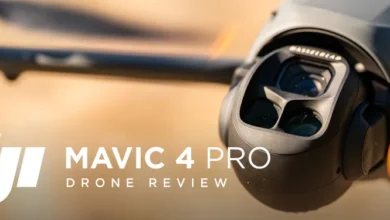
The Mavic 4 Pro looks and feels like a tool built for professionals. Its near-spherical gimbal housing and sleek gray airframe are a clear evolution from the Mavic 3 Pro – more refined, less angular, and purposeful. Unfolding the arms automatically powers it on, a small but brilliant UX improvement that eliminates extra steps. Six fish-eye lenses (three top, three bottom) give it full omnidirectional awareness, and the forward-facing LiDAR sensor adds confidence in low-light navigation.
At 1063 grams, it’s the heaviest Mavic yet – but not unwieldy. It carries its weight well, and that extra mass translates to stability in wind. I’ve flown it in 12 m/s gusts without hesitation. That said, the folding joints on the rear arms feel less robust than I’d like. I treat them with care, and I’ve heard similar concerns from other pilots. It’s not a deal-breaker, but at this price, you expect perfection.
Real-World Speed
Specs say 51 minutes of flight time – and while that’s measured in ideal conditions, I consistently get 42–47 minutes in real-world use (mixed shooting, wind, altitude changes). That’s still exceptional. Combined with a top speed of 90 kph in Sport mode and a 41 km range, the Mavic 4 Pro covers ground fast. I’ve used it to scout locations, chase moving vehicles up to 200m away, and capture time-lapses across vast landscapes – all without rushing.
The O4+ transmission system is a silent hero. Flying in cities with heavy RF interference, I’ve had zero dropouts. The 10-bit HDR feed stays crisp, and the higher bitrate means smoother preview footage when framing shots. Group flying? No longer a signal nightmare. It plays nice with other pilots.
The Lens Lowdown
The triple-camera system is where the Mavic 4 Pro truly shines. You get three distinct perspectives without swapping lenses or drones:
- Main Wide (28mm, 1x): Slightly less wide than the Mavic 3 Pro’s 24mm, but the reduced distortion makes it far more usable for architecture and landscapes. 6K video at 60fps with All-I codec (Creator Combo) gives editors immense flexibility.
- Mid Telephoto (70mm, 2.5x): Perfect for portraits, compressed landscapes, and detail shots. 4K/120fps slow-mo adds creative flair. Dual Native ISO Fusion delivers clean footage even at night.
- Long Telephoto (168mm, 6x): Ideal for isolating subjects from afar – wildlife, vehicles, or distant landmarks. 4K/100fps HDR video with excellent dynamic range. Blue hour shots? Stunning. Full darkness? Still impressively clear.
All three cameras support D-LOG, D-LOG M, and HLG, ensuring color consistency across lenses. The ability to tilt the gimbal opens new angles for social media and dynamic storytelling – something I didn’t think I’d use, but now appreciate.
Final Score
9.2 / 10 – Outstanding
A pro-grade drone that earns its keep through reliability, image quality, and intelligent design. Not perfect – but close.
Tags: DJI Mavic 4 Pro, drone review, long-term test, 6K video, triple camera, O4+ transmission, ActiveTrack 360, LiDAR obstacle avoidance, RC Pro 2, flight time, telephoto drone, professional drone, aerial photography, cinematic drone, EU C2 drone