Verdict in 10 Seconds: Yes – if you can find one at a steep discount, this 2020-era gem still delivers elite CPU performance and portability that few modern laptops match in its size class.
The Good & The Bad
- CPU Powerhouse: The Ryzen 7 4800HS (and 4900HS) still crush multithreaded tasks – video editing, coding, rendering – outpacing many thicker 2026 laptops with weaker cores.
- Portability Champion: At just 3.5 lbs and 14 inches, it’s lighter and more travel-friendly than nearly every modern gaming or creator laptop.
- Premium Build: Magnesium-aluminum chassis feels like a “mini-tank” – solid, rigid, and built to last years beyond its warranty.
- Battery Life Surprise: With the dGPU disabled and display at 60Hz, you can squeeze 8–10 hours of light work – rare for a gaming rig.
- AniMe Matrix Flair: The customizable LED lid adds personality without sacrificing professionalism (when turned off).
- GPU Limitation: The 65W RTX 2060 Max-Q is outclassed by 2026’s RTX 5000 series – struggles with ray tracing and newer AAA titles at high settings.
- Thermal Throttling: Under sustained load, internal temps soar; external surfaces get uncomfortably warm near the rear vents.
- Non-Upgradable RAM: 16GB soldered means no future expansion – problematic for heavy multitaskers or AI workloads in 2026.
- Display Dated: No OLED, no 120Hz+ refresh rate, and glossy coating causes glare – modern G14s offer far superior screens.
- Availability & Price: As a discontinued model, prices vary wildly; paying near original MSRP in 2026 is a bad deal.
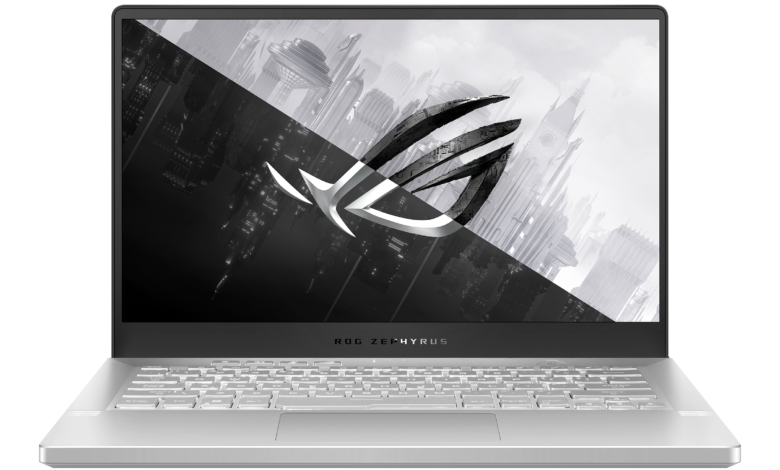
When the ASUS ROG Zephyrus G14 GA401IV launched in 2020, it rewrote the rules for what a 14-inch laptop could do. Six years later, it’s no longer the bleeding edge – but in a world obsessed with thinner bezels and AI stickers, its raw efficiency and no-nonsense design feel almost refreshing.
In The Hand
The G14 GA401IV feels premium from the moment you lift it. The magnesium-aluminum alloy doesn’t flex, creak, or weigh you down. The 130-degree hinge opens smoothly, and the keyboard – with 1.7mm travel – is still one of the best on any ultraportable. The large glass touchpad is responsive, though the lack of a fingerprint sensor feels like a missed opportunity even in 2020. Compared to the 2026 Zephyrus models with their sleek OLEDs and liquid metal cooling upgrades, this older unit looks modest – but its build quality holds up shockingly well.
Real-World Speed
In daily use, the Ryzen 7 4800HS remains shockingly capable. Compiling code, streaming 4K video while browsing, and even light DaVinci Resolve projects run smoothly. The RTX 2060 Max-Q handles esports titles (Valorant, CS2, Rocket League) at 1080p High with 100+ FPS, but struggles with Cyberpunk 2077 or Starfield – even at Medium settings, you’ll see dips below 40 FPS. Remember: enable “Turbo” mode in Armoury Crate for a noticeable 10–15% performance bump. Without it, you’re leaving free speed on the table.
Can It Shoot?
Not in the way 2026 gamers expect. While it can run most games, the 65W GPU and aging architecture mean you’ll need to lower settings for smooth gameplay in newer titles. That said, for indie games, older AAA classics, or cloud gaming via GeForce NOW, it’s more than adequate. Just don’t expect to max out Elden Ring or Alan Wake 2.
Final Score
8.2 / 10 – Still Impressive, But Shop Smart
A legendary compact performer that ages like fine wine – if you catch it under $900.
Tags: ASUS ROG Zephyrus G14, GA401IV review 2026, Ryzen 7 4800HS laptop, RTX 2060 Max-Q performance, best 14-inch gaming laptop, portable gaming laptop 2026, AMD vs Intel laptops, laptop thermal performance, upgradable RAM laptops, OLED vs LCD gaming, AniMe Matrix laptop, ASUS Zephyrus long-term review, budget gaming laptop 2026, compact creator laptop, discontinued laptop value